Thursday, 28 June 2012
Correctly Fitting A Helmet
The correct technique to put a helmet on is that firstly you must put it on your head with the lowest bit and the tightening device at the back of your head and you must tighten your healmet so that it wont fall off and then you must clip the straps together underneath your chin so it is snug enough for a strong hold, without being too tight. Make sure the straps aren’t slack. If this is done properly then it will not fall off your head and provide maximum protection.

Climbing - Mantel Shelf Technique
Mantel Shelf - This is were the climber is trying to get onto a ledge round about chest height. To do this they will put both their hands onto the ledge and pull their body weight upwards so that their body is moving up towards to top of the rock then about half way up their body he will start to push down on the ledge until they are able to put on of their legs onto the rock and pull the rest of there body up. This move is usually performed when good handholds above the ledge either do not exist or are not reachable.

To perform the layback and the mantel shelf you need to use both your hands and feet to climb but the lay back is better used when attempting to climb a corner or a crack in a rock face and the mantel shelf is better for climbing up onto ledges and over rock faces.
When i tried both of these techniques i found the layback difficult becuase it put alot of strain onto my body especially my arms and shoulders, i injured my shoulder while doing this. so this wouldnt be very good if i was planning a long climb. Were as the mantel shelf just felt natural becuase it is the same technique as getting out a swimming pool. When doing this climb you have to make sure you bring your foot up and place in on the top of the ledge rather then your knees.
How To Correctly Fit A Harness
When you are putting your harness on you need to make sure that it fits comfortably and correctly becuase with any piece of equipment or clothing that you wear they will never be 100% comfortable unless they fit.
A harness is used to secure a person to a piece of rope or an anchor point in rock climbing, absailing etc.
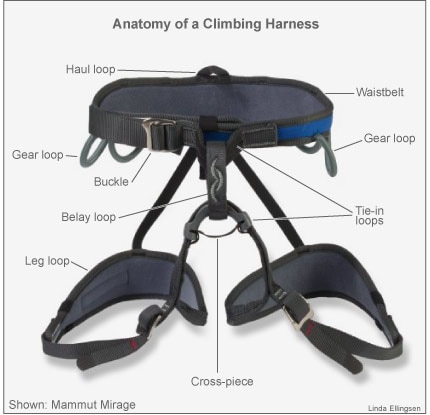
 This is what a Harness looks like, and the different parts are:
Waistbelt .This is the main belt on the harness. Various designs and materials are used to achieve the maximum amount of comfort with the minimum amount of weight. The back buckles help to adjust the belt to your comfort. The waistbelt should settle just above your hipbones and should not be able to be pulled down over your hips.Make sure your waistband isn’t restricting your breathing.
Buckles: These consist of 1 or 2 pieces of metal to allow for manual double–back or automatic double–back respectively. The buckle is usually a bit off–center to avoid conflict with rope tie–in. A harness must have a buckle for the waistbelt but does not necessarily need buckles on the leg loops.
A harness is used to secure a person to a piece of rope or an anchor point in rock climbing, absailing etc.
This is what a Harness looks like, and the different parts are:- Leg Loops:-The loops should compromise between not being able to slide around, without hindering your movement.Gear loops are there to clip your karabiners or protection equipment to.
The Correct Technique For Belaying
Belaying is an important technique to have when rock climbing. It is a technique used to control the rope so that a falling climber will not fall very far and will be caught by the rope. The belayer is the person in control of the ropes as the climber is ascending the wall or rock. The belayer passes rope through a belay device, which allows the rope to flow freely while the climber is ascending. In the event of a fall, the belay device will lock off the rope to stop the fall.

Proper belaying technique is essential in climbing to ensure safety of the climber, especially a lead climber that is establishing a route. If a climber were to fall, the belayer would be able to hold the entire weight of the climber and to help lower them to an area where they may continue climbing.
Belaying is the act of securing the climber while he/she climbs. The belayer controls the rope during a climb and is there in the event of a fall and to lower the climber. There are three types of belaying in climbing.The belayer must be attentive at all times and feed the rope at an appropriate pace. The belayer must anticipate when the leader needs the rope slacking or tightened.
In a fall, the climber is not always able to give a warning and the belayer must be ready at all times.
In direct belaying, the load of a fall is transferred to an anchor without the weight being taken by the belayer first. This is common when the belayer is above the climber such as after the leader has reached the summit and the second climber is coming from below.
Whatever anchor is used must be one hundred percent safe. A sling on a solid spike, rock or tree is commonly used. Do not use a tree or rock if its sturdiness is questionable. A friction device such as an Italian hitch is better in a direct belay.
The indirect belay is when the belayer takes the load in the waist but the belayer is supported by the anchors. This method is also used if you attach to the anchors from the back of the harness and belay from the front. This system can be uncomfortable for the belayer as they take the whole load in their waist.
This is commonly used when the anchors are weak.
Most climbers use the semi-direct belay method, but their may be some cases when you need to use a different method. The person belaying should be very comfortable doing so and experienced with the method that is used.
Proper belaying technique is essential in climbing to ensure safety of the climber, especially a lead climber that is establishing a route. If a climber were to fall, the belayer would be able to hold the entire weight of the climber and to help lower them to an area where they may continue climbing.
Belaying is the act of securing the climber while he/she climbs. The belayer controls the rope during a climb and is there in the event of a fall and to lower the climber. There are three types of belaying in climbing.The belayer must be attentive at all times and feed the rope at an appropriate pace. The belayer must anticipate when the leader needs the rope slacking or tightened.
In a fall, the climber is not always able to give a warning and the belayer must be ready at all times.
In direct belaying, the load of a fall is transferred to an anchor without the weight being taken by the belayer first. This is common when the belayer is above the climber such as after the leader has reached the summit and the second climber is coming from below.
Whatever anchor is used must be one hundred percent safe. A sling on a solid spike, rock or tree is commonly used. Do not use a tree or rock if its sturdiness is questionable. A friction device such as an Italian hitch is better in a direct belay.
The indirect belay is when the belayer takes the load in the waist but the belayer is supported by the anchors. This method is also used if you attach to the anchors from the back of the harness and belay from the front. This system can be uncomfortable for the belayer as they take the whole load in their waist.
This is commonly used when the anchors are weak.
Most climbers use the semi-direct belay method, but their may be some cases when you need to use a different method. The person belaying should be very comfortable doing so and experienced with the method that is used.
Subscribe to:
Posts (Atom)